
Coatings and Corrosion Resistance
Sintered NdFeB Magnet Surface Coatings and Corrosion Resistance
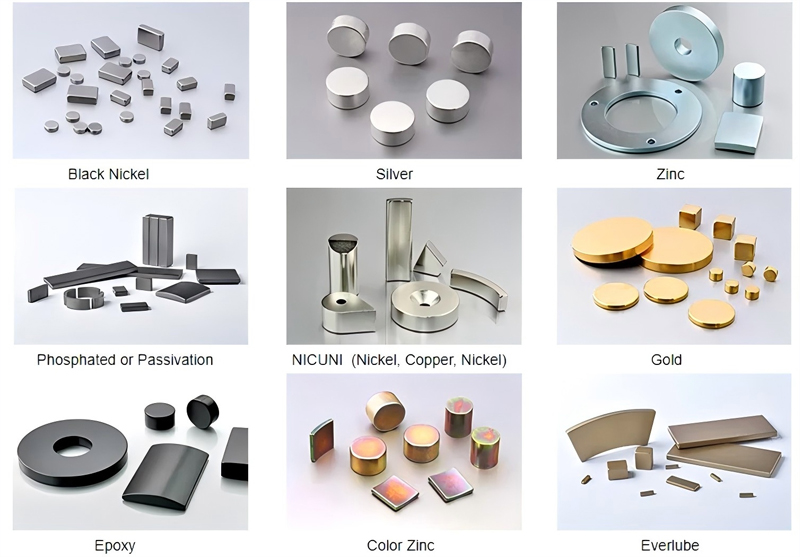
Sintered NdFeB magnets are highly brittle and prone to corrosion, especially in humid or acidic environments. Therefore, surface coatings are essential to protect the magnet, extend service life, and maintain magnetic performance.
| Coating | Description | Corrosion Resistance | Typical Applications |
|---|---|---|---|
| Ni-Cu-Ni (Nickel-Copper-Nickel) | Electroplated three-layer coating | Good | Standard industrial use, motors, sensors |
| Zn (Zinc) | Single-layer electroplating | Moderate | Cost-effective protection, moderate environments |
| Epoxy (Epoxy Resin Coating) | Thick polymer coating | Excellent | Harsh environments, moisture-prone applications |
| Gold (Au) | Decorative or electronic-grade coating | Excellent for chemical corrosion, aesthetic | High-end electronics, connectors |
Corrosion Resistance Performance
Ni-Cu-Ni: Provides a uniform barrier and protects magnets from mild moisture and oxidation. Standard choice for most industrial applications.
Zinc: Economical option but less durable; suitable for indoor or low-humidity environments.
Epoxy: Excellent protection against water, humidity, and chemical attack; suitable for long-term outdoor or aggressive environments.
Gold: Mostly for specialized electronics; prevents oxidation and improves electrical contact reliability.
Key Notes on Surface Protection
Coating Thickness: Typically 5–20 µm (Ni-Cu-Ni), 10–25 µm (Epoxy). Thicker coatings improve corrosion resistance but may affect tight dimensional tolerance.
Environmental Factors: Acidic, salty, or humid environments accelerate corrosion; choose coatings accordingly.
Magnetic Performance: Proper coatings do not significantly affect Br or BHmax, but damaged or incomplete coatings may lead to localized corrosion and performance degradation.
Custom Solutions: For special applications, multi-layer coatings or epoxy plus nickel can be used for enhanced durability.