
Ferrite Permanent Magnet Manufacturing Process
Ferrite Permanent Magnet Manufacturing Process
Ferrite permanent magnets, also known as ceramic magnets, are widely used in motors, loudspeakers, sensors, and magnetic assemblies due to their excellent corrosion resistance, cost efficiency, and stable magnetic performance.
The manufacturing of ferrite magnets involves a precise powder metallurgy process, including raw material preparation, calcination, milling, forming, sintering, machining, and magnetization. Each stage is strictly monitored under international quality standards to ensure consistent magnetic performance and dimensional accuracy.
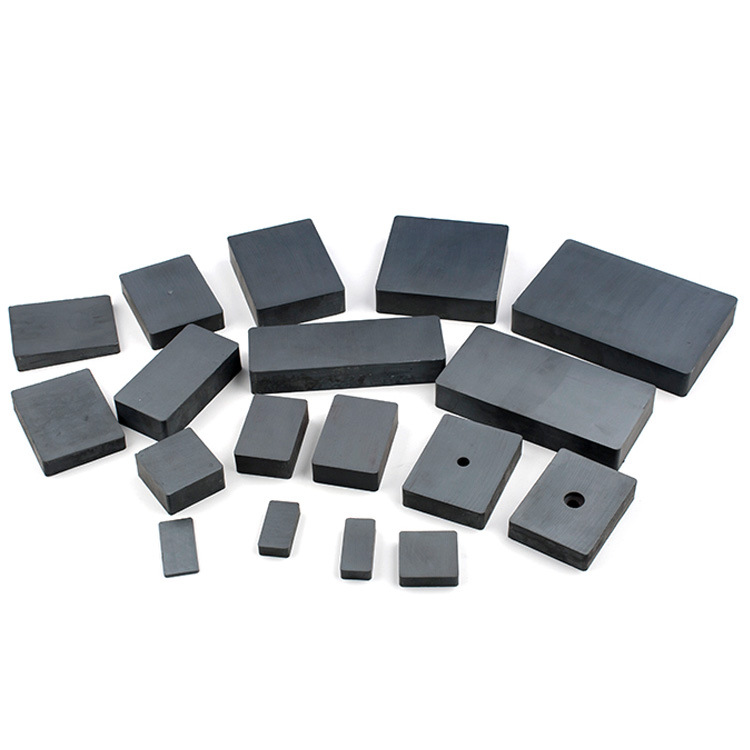
Block Ferrite Magnet
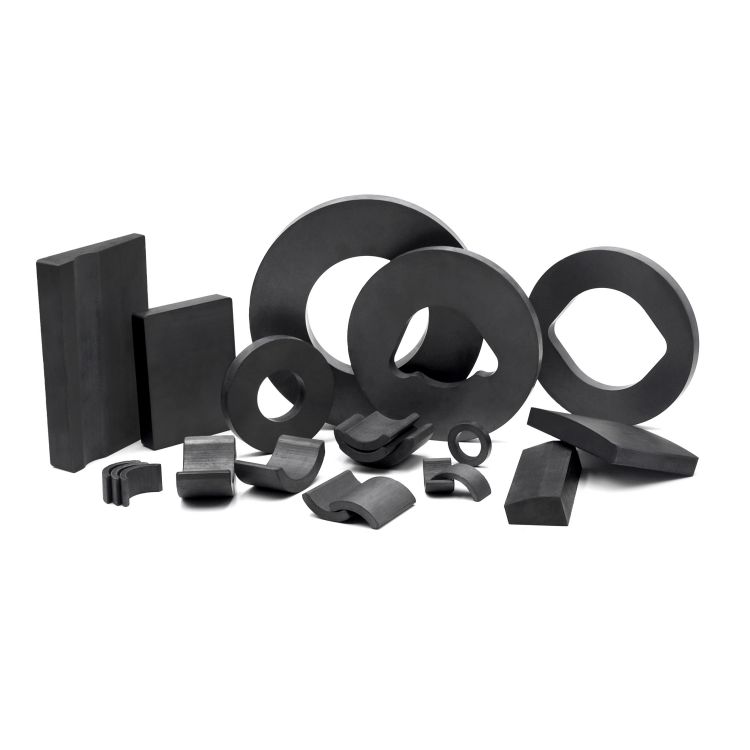
Ferrite Magnet For Mortor & Speaker
1. Raw Material Preparation
Ferrite magnets are mainly produced from high-purity iron oxide (Fe₂O₃) combined with barium carbonate (BaCO₃) or strontium carbonate (SrCO₃).
These raw materials are carefully weighed and mixed to ensure the correct stoichiometric ratio required for ferrite crystal formation.
Quality Control
Before entering the production process, all raw materials undergo strict inspection:
Chemical composition analysis (XRF or ICP)
Particle size distribution testing
Moisture content measurement
Impurity control
Inspection Standards
Chemical purity ≥ 98%
Controlled particle size distribution
Compliance with internal raw material acceptance specifications

2. Calcination (Pre-Sintering Reaction)
The mixed powders are heated in a rotary kiln or tunnel furnace at temperatures typically between 1000°C and 1200°C.
During calcination, the raw materials chemically react to form the ferrite crystal phase, which is essential for achieving stable magnetic properties.
Quality Control
Calcination temperature monitoring
Phase composition verification
Uniform reaction control
Inspection Standards
X-ray diffraction (XRD) phase analysis
Calcined powder magnetic property testing
Batch consistency inspection

3. Fine Milling
After calcination, the ferrite material is crushed and milled into fine powder using ball mills or jet mills.
This step significantly influences the grain size and magnetic orientation capability of the final magnet.
Quality Control
Particle size distribution control
Slurry density monitoring
Milling time optimization
Inspection Standards
Particle size typically controlled between 0.7–1.5 μm
Laser particle size analyzer testing
Slurry viscosity measurement

4. Magnetic Forming (Pressing)
The ferrite powder slurry is pressed into shape using either dry pressing or wet pressing under strong magnetic fields to orient the particles.
This step determines whether the magnet is:
Isotropic ferrite magnet (no magnetic orientation)
Anisotropic ferrite magnet (aligned magnetic structure)
Quality Control
Pressing pressure monitoring
Magnetic field strength control
Green density measurement
Inspection Standards
Green density uniformity testing
Dimensional tolerance inspection
Orientation efficiency verification

5. Sintering
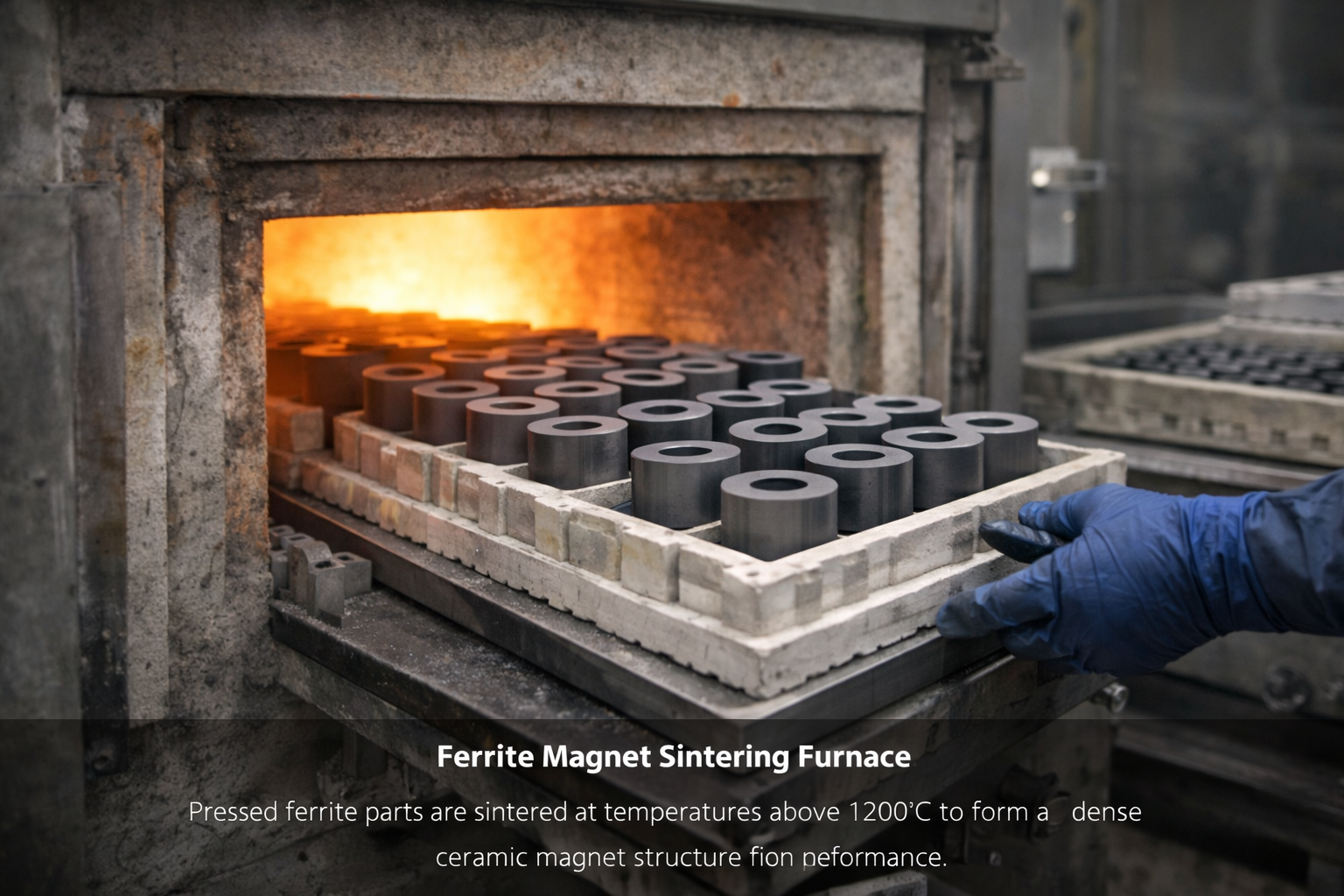
The pressed ferrite parts are sintered at temperatures between 1200°C and 1300°C in a controlled furnace environment.
Sintering allows the powder particles to bond together, creating a dense ceramic structure with stable magnetic properties.
Quality Control
Furnace temperature uniformity
Sintering atmosphere control
Shrinkage ratio monitoring
Inspection Standards
Density measurement
Microstructure inspection
Magnetic property testing (Br, Hc, BHmax)
6. Machining and Finishing
After sintering, ferrite magnets are extremely hard and brittle. Diamond grinding machines are used to achieve precise dimensions and tight tolerances.
Common processes include:
Surface grinding
Centerless grinding
Cutting or slotting
Chamfering
Quality Control
Dimensional inspection
Surface finish measurement
Edge integrity inspection
Inspection Standards
Tolerance control (typically ±0.02–0.05 mm)
Surface roughness inspection
Visual defect inspection

7. Magnetization
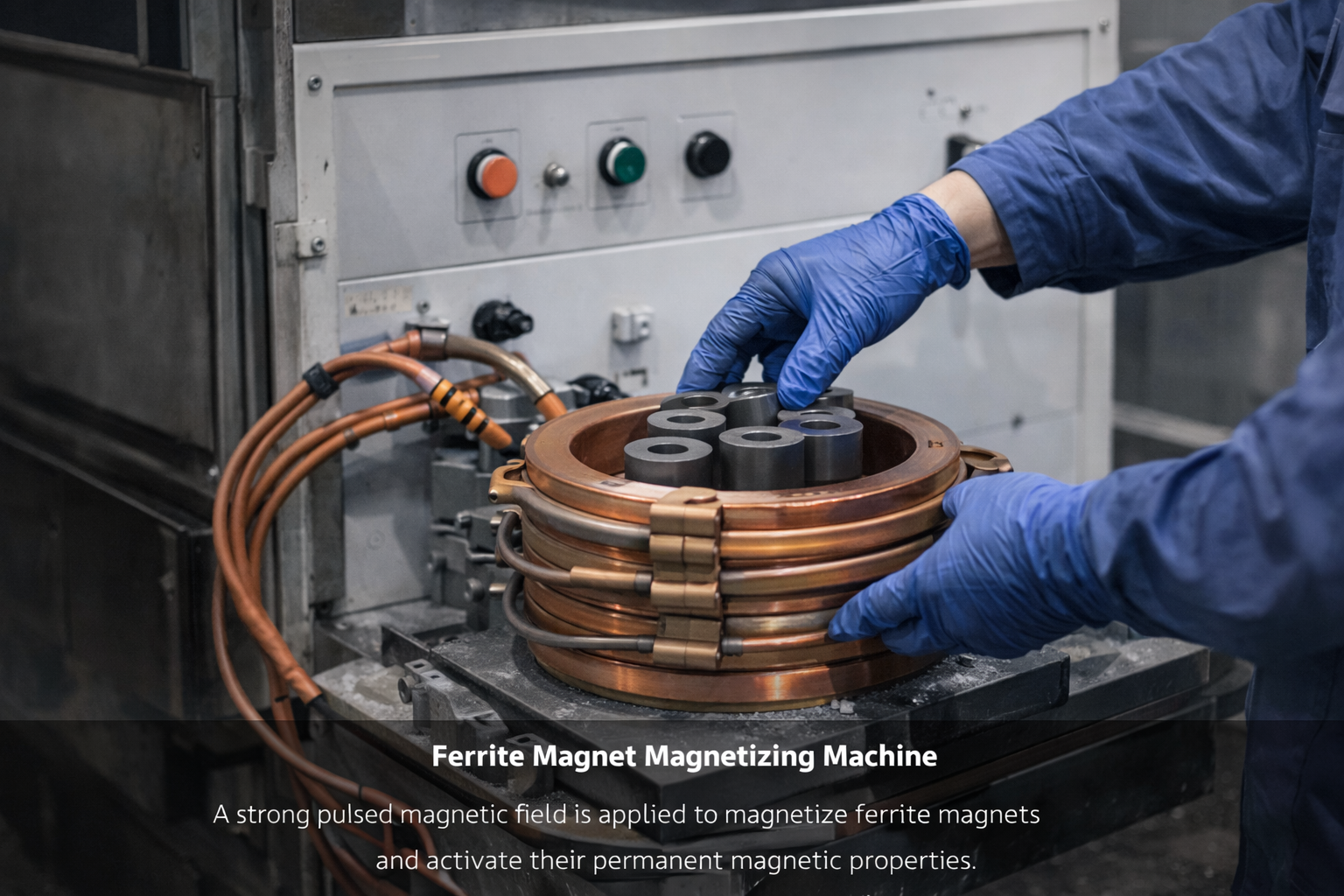
The final step is magnetization using a high-energy magnetizing machine. The magnets are exposed to a strong pulsed magnetic field to achieve their permanent magnetic state.
Different magnetization patterns can be applied depending on the application.
Quality Control
Magnetizing field verification
Flux density measurement
Pole pattern verification
Inspection Standards
Gauss meter testing
Flux measurement
Magnetic field distribution inspection
Final Quality Inspection
Before shipment, ferrite magnets undergo comprehensive inspection to ensure compliance with customer specifications.
Final Inspection Items
Magnetic properties (Br, Hcb, Hcj, BHmax)
Dimensional tolerance
Appearance inspection
Magnetic flux consistency
Testing equipment commonly used:
Hysteresis graph analyzer
Gauss meter
Flux meter
Precision dimensional measuring instruments

Quality System and Production Capability
Manufacturing processes are typically managed under strict quality systems to ensure consistency and reliability.
Common quality standards include:
ISO 9001 Quality Management System
IATF 16949 Automotive Quality Standard
RoHS and REACH compliance
With advanced powder metallurgy technology and strict process control, ferrite magnets can achieve stable performance suitable for demanding industrial applications.
Custom Magnet Solutions
Magnet Forever specializes in the development and manufacturing of high-quality neodymium magnets for global customers.
We provide:
custom magnet design
OEM manufacturing
strict quality control
reliable global supply
If you need professional support for magnet applications, our engineering team will be happy to assist you.
Contact Us
Looking for high-performance magnets for your application?
Contact us today to discuss your project and receive customized magnet solutions.
Request a Quote
Send Your Drawing