
Why Can Pot Magnets of the Same Size Have Very Different Pull Forces?
Why Can Pot Magnets of the Same Size Have Very Different Pull Forces?
Many buyers ask a simple question when sourcing pot magnets:
“How many kilograms can a D25 pot magnet hold?”
From a manufacturer’s point of view, that question is incomplete.
The actual holding force of a pot magnet is not determined by diameter alone. Even two products with the same D25mm outer diameter can show very different pull-force results.
The final performance depends on the magnet, steel cup, contact surface, and test conditions working together.
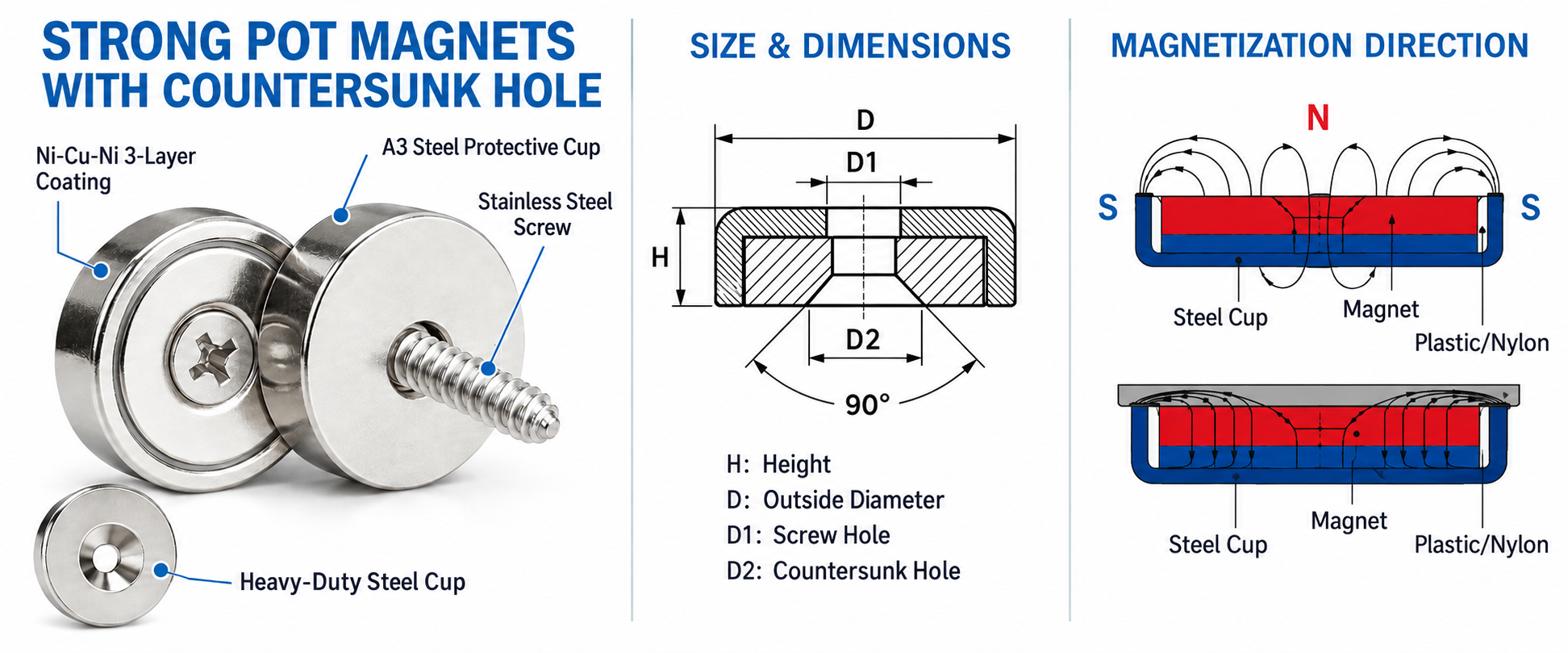
1. A Pot Magnet Is More Than “a Magnet Inside a Steel Cup”
A typical pot magnet consists of:
* Neodymium magnet
* Steel cup
* Mounting hole or threaded structure
* Optional rubber, plastic, or protective layer
The steel cup is not only there to protect the magnet.
It also affects the magnetic circuit.
If the cup thickness, bottom structure, or edge dimensions are not properly designed, the magnetic field may not be concentrated efficiently on the working face. In that case, simply using a higher magnet grade may not produce the expected increase in holding force.
That is why, for custom pot magnets, we do not look only at N35, N42, or N52. We evaluate the complete structure.
2. Same Diameter, Different Magnet Thickness, Different Result
Buyers often compare two pot magnets only because they have the same outside diameter.
But if the internal magnet thickness is different, the pull-force results may not be comparable.
For example, two D32mm pot magnets may look almost identical from the outside, while one contains a thinner magnet and the other a thicker one.
Their magnetic performance can therefore be very different.
For projects where holding force matters, we recommend confirming at least:
* Outside diameter
* Overall height
* Internal magnet thickness
* Magnet grade
* Steel cup structure
Looking only at the outer diameter can easily lead to the wrong selection.
3. Steel Plate Thickness Directly Affects Pull-Force Testing
This is one of the most commonly overlooked points in pot magnet testing.
Pull force is normally measured against a steel plate.
If the test plate is too thin, the steel can saturate quickly, and the measured value may be lower than the magnet’s actual capability.
In other words:
The same pot magnet can produce different test results on steel plates of different thicknesses.
So if Supplier A and Supplier B use different test conditions, their pull-force numbers should not be compared directly.
For bulk projects, we recommend confirming:
* Steel plate material
* Steel plate thickness
* Contact area
* Pulling direction
* Whether an air gap is present
Only under the same test conditions do the numbers become meaningful.
4. Flat Contact Can Matter More Than a Higher Magnet Grade
Pot magnet performance is highly dependent on contact condition.
If the working surface has:
* Paint
* Plastic film
* Powder coating
* Rust
* Curved geometry
* Uneven contact
an air gap is created.
Even a small air gap can cause a noticeable drop in holding force.
This is why some customers see good laboratory pull-force results but weaker performance after the magnet is installed in the final product.
The issue is not always the magnet itself.
Quite often, the actual mounting surface is different from the test surface.
From a manufacturer’s perspective, we care more about where and how the magnet will actually be used than about maximizing a theoretical pull-force number.
5. Countersunk Holes Also Affect the Magnetic Structure
A countersunk hole may look like a simple mechanical feature, but it changes the available space inside the steel cup.
This is especially important for smaller pot magnets with screw holes such as M4, M6, or M8.
The larger the hole, the less room remains for magnetic material.
So it is not always correct to assume:
“Keep the same D25 body, change M4 to M8, and everything else stays the same.”
In practice, we may need to adjust:
* Magnet thickness
* Steel cup thickness
* Countersunk dimensions
* Overall height
to maintain a similar holding force.
6. Rubber-Coated and Bare Steel Pot Magnets Should Not Be Compared in the Same Way
Rubber-coated pot magnets are commonly used on:
* Painted surfaces
* Furniture
* Automotive surfaces
* Equipment housings
* Finished metal surfaces
The rubber layer improves friction and protects the surface.
However, it also increases the distance between the magnet and the steel plate.
As a result, pure vertical pull force is usually lower than that of a bare steel pot magnet.
But in real horizontal or anti-slip applications, the extra friction from the rubber can make the product more stable.
So rubber-coated pot magnets should not be judged only by a single pull-force value.
The real question is whether the application requires:
vertical pull-off resistance or resistance to sliding.
7. N52 Is Not Always the Most Practical Choice
Many inquiries specify N52 from the beginning.
But for pot magnets, magnet grade is only one part of the system.
If:
* The steel cup is not optimized
* The contact surface is uneven
* The air gap is large
* The mounting structure is inefficient
upgrading from N35 to N52 may not produce as much improvement as expected.
For repeat and high-volume projects, we usually prefer to start with the required holding force and then work backward to the appropriate structure and magnet grade.
This is often more economical than automatically choosing the highest grade.
8. For Bulk Orders, Consistency Matters More Than One Strong Sample
A sample meeting the target pull force does not guarantee that tens of thousands of pieces will perform the same way.
For mass production, more attention should be paid to:
* Magnet dimension consistency
* Steel cup dimensions
* Magnet grade
* Bonding or assembly condition
* Coating
* Magnetization
* Pull-force inspection method
For repeat orders, we normally keep the confirmed specifications and test conditions on record.
This helps later production batches remain consistent with the approved sample and previous deliveries.
What Information Should Buyers Provide?
If your project has a clear holding-force requirement, it is better not to send only:
“Need D32 strong pot magnet.”
A more useful request would be:
D32 × H8mm
M6 countersunk hole
Target pull force: 25 kg
Installed on 5mm steel plate
Vertical pull
Quantity: 20,000 pcs
With this information, the manufacturer can properly evaluate:
* Whether the current structure is suitable
* Whether a higher magnet grade is needed
* Whether the magnet should be thicker
* Whether the steel cup design should be changed
* Whether the target force is realistic for mass production
Conclusion
Pot magnets may look simple, but in practice they are small magnetic-circuit systems.
Outside diameter, magnet thickness, magnet grade, steel cup design, hole size, contact surface, and test conditions all affect the final result.
For bulk purchasing, the most important question is not simply who can provide the highest “kg” number.
The more important question is whether that performance can be reproduced under the actual working conditions and maintained consistently in mass production.
That is why custom pot magnet projects should start from the real installation conditions, rather than selecting a model only from a size table.