
Industrial Magnetic Filter Bars and Separation Systems
A 50-Micron Iron Particle Just Destroyed Your $200,000 Batch. Here Is How to Stop It.
One iron particle. Fifty microns across. Smaller than a human hair. It drifts through your production line, triggers the metal detector, and your entire batch is quarantined.
If you process food, that is a lot rejection. If you make lithium-ion battery cathode powder, it is a short-circuit risk that can escalate to thermal runaway. If you run a chemical plant, it is catalyst poisoning and product discoloration. Same root cause every time: a magnetic separator that let a particle through.
Most procurement teams buy magnetic filter bars by asking for "the 12000GS one" and comparing prices. That approach guarantees you will be the engineer explaining to your boss why a $200,000 batch just went into the incinerator.
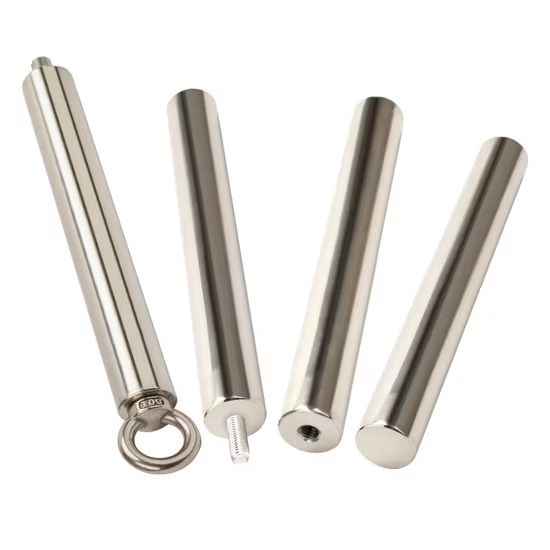
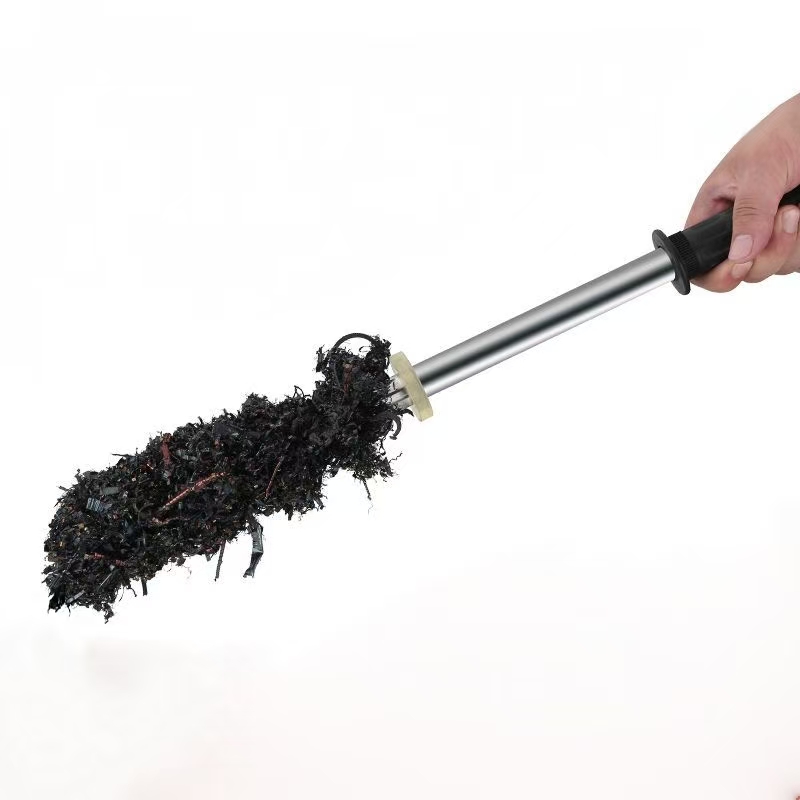
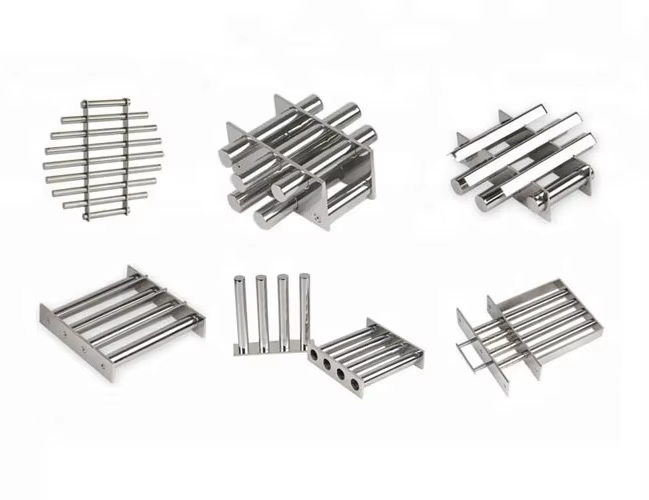
The difference is not a stronger magnet grade. It is the internal array geometry. We use a stacked-disc NdFeB configuration with alternating N-S pole orientation. That creates a steep magnetic field gradient. The rod captures sub-50-micron ferrous particles at depths where a standard rod is effectively blind.
Ask any supplier for their field gradient curve, not just their surface Gauss number. If they cannot produce one, walk away.
NdFeB grade determines how your rod behaves at temperature
Every magnetic filter bar uses sintered neodymium. But the grade matters enormously once your process heats up.
N35 through N42 works fine at room temperature. At 80°C, remanence starts dropping fast. For CIP (Clean-in-Place) systems that flush at 90°C to 120°C, you need N48H or above. For compact-diameter rods where you are fighting for every Gauss of surface field, N52 is worth the premium.
We manufacture all grades in-house, N35 through N52, with raw material traceability back to rare-earth batch. Monthly NdFeB output is 20+ tons. That volume means the magnetic performance of your rod from order #1 matches order #10. No "lucky batch" lottery.
The stainless steel housing is where most rods eventually fail
Two rods. Same Gauss rating. Same diameter. One lasts six months. The other lasts ten years. The difference is in the metalwork.
Tube material is the first decision. 304 stainless covers most applications. But if your process involves citric acid CIP, brine solutions, or chloride-rich food products, downgrading to 304 saves pennies and costs you a rod replacement within a year. 316L is what you actually need. We stock both and will tell you which one your application requires. If you are not sure, send us your process parameters and we will make the call.
Tube wall thickness is a trade-off. 1.0mm transmits the strongest magnetic field but sacrifices mechanical strength. 1.5mm is the sweet spot for most installations. We offer 0.8mm to 2.5mm depending on your pressure rating.
End-cap welding sounds boring until a pinhole lets process fluid inside the tube. We TIG-weld every cap with full-penetration beads and post-weld passivation. No crevices. No bacterial growth points. For food-grade applications, surface finish hits Ra ≤ 0.8μm. Mirror polish is standard for food. Brushed finish for industrial.
Off-the-shelf rods cover about 70% of applications. You might be in the other 30%.
Standard sizes like D25mm × 200mm or D32mm × 300mm work for most installations. But if your equipment has a non-standard housing, custom engineering should not take three months.
We do non-standard diameters from D12mm to D100mm. Extended lengths up to 3 meters with multi-section construction. U-shape, L-shape, and Z-shape bends for grate configurations. Threaded end connections in M6, M8, M10, or M12 for easy removal and cleaning. Integrated scraper sleeves for manual-clean systems.
Our engineering team controls both the magnet production and the stainless steel fabrication. That means a custom rod goes from your drawing to a prototype in 15 workdays.
For bulk material processing, you need a drum, not a rod
When you are running tons per hour of mineral powder, ceramic slurry, or recycled material through a magnetic separator, filter bars are too small. You need a magnetic roller or drum.
We build custom NdFeB magnetic rollers from 10,000 to 20,000 Gauss, with 360° magnetic arc coverage. Diameters from 100mm to 600mm. Widths up to 1,500mm. Motorized or gravity-fed. Wet or dry processing. Available from one unit for pilot testing.
Every rod we ship comes with paperwork that proves what it does
Material certificate to EN 10204 3.1 for the stainless steel. Magnetic performance test report with surface Gauss at three points per rod. Surface finish certification with Ra value for food-grade applications. RoHS and SGS compliance documentation. BSCI social compliance audit for your ethical sourcing requirements.
If a supplier cannot provide these documents for a rod you are buying for a regulated process, you are taking on liability that belongs on their desk.
How to get a rod that matches your process
Send us your spec: rod diameter, length, target Gauss, housing material, and connection type. You get a custom engineering proposal within 24 hours. 3D CAD drawing included. Magnetic field simulation included. Prototype ships in 15 days. Volume production in 20 to 30 days.
Next step
Send your magnet specification drawing. Our engineering team returns a magnetic performance simulation (BH curve plus demagnetization analysis at your operating temperature), a PPAP sample quotation, and a coating compatibility recommendation for your rotor cavity environment. All within 48 hours.
📧 Contact Magnet Forever on Alibaba.com | 🌐 https://www.magnet-forever.com