
How to Choose Magnets for Cabinets and Furniture Manufacturing
Best Magnets for Cabinets: Types, Sizes and Selection GuideMagnets used in cabinets may look like small components, but the choice of magnet can affect how a cabinet door closes, how easily a removable panel can be opened, and how the magnetic part is installed during production.
For cabinet and furniture manufacturers, there is no single magnet that works for every design. A small concealed door closure, a removable metal panel and a heavy cabinet door may require completely different magnetic structures.
As a neodymium magnet manufacturer, we usually recommend choosing the magnet according to the cabinet structure first, then considering magnetic grade and size.
Here are several magnet types commonly used in cabinets and furniture products.
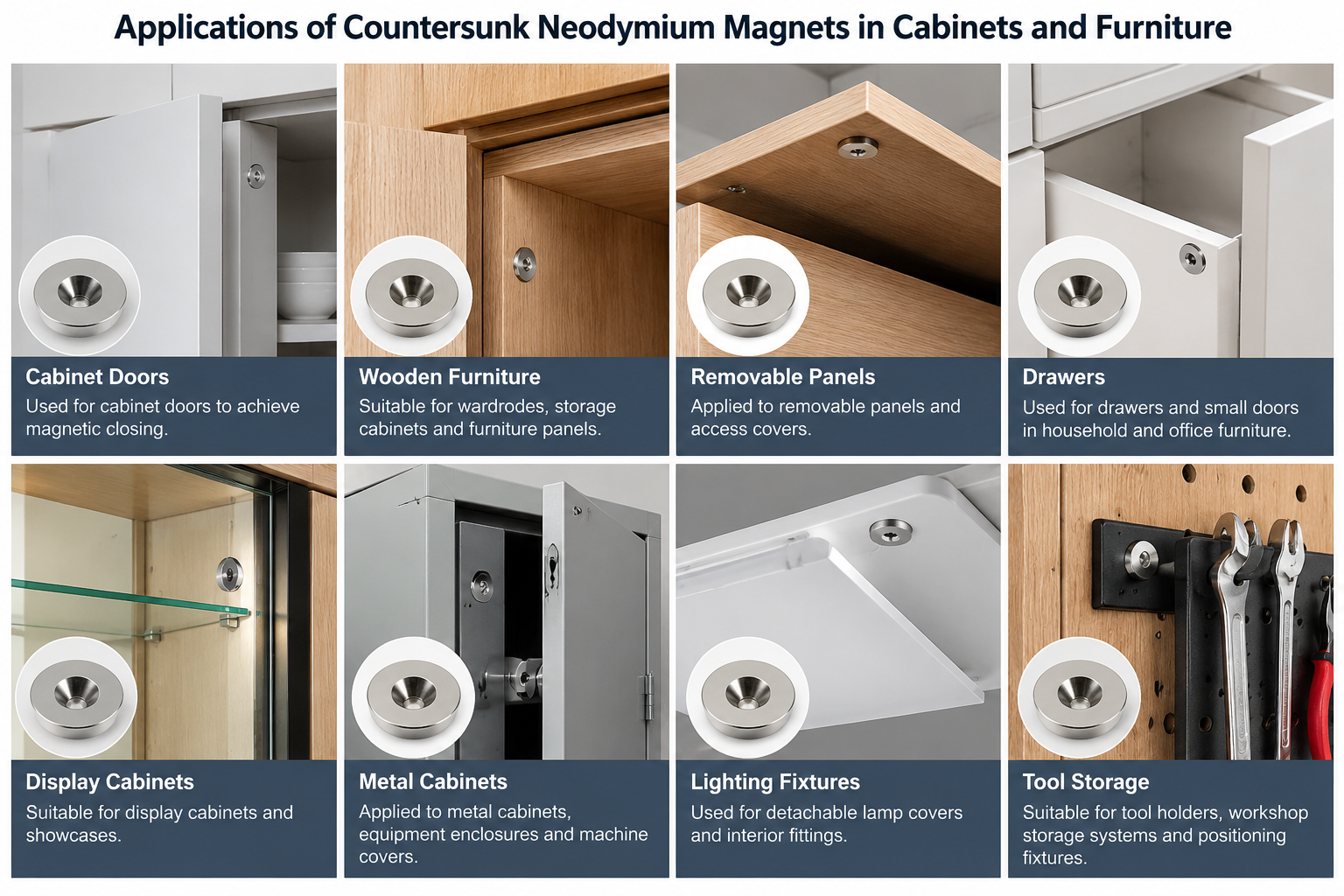
1. Countersunk Neodymium Magnets
Countersunk neodymium magnets are a practical choice when the magnet needs to be fixed directly to a cabinet, door or furniture component with a screw.
A countersunk hole in the center allows a flat-head screw to sit inside the magnet, creating a compact installation without requiring a separate magnet holder.
They can be used for:
cabinet doors;
wooden storage cabinets;
removable furniture panels;
access covers;
hidden magnetic closures;
display cabinets.
For furniture manufacturers, another advantage is dimensional flexibility. The magnet diameter, thickness, through hole and countersunk diameter can be produced according to the available mounting space.
Common screw options include M3, M4, M5 and M6, while non-standard countersunk holes can also be manufactured according to drawings.
For products that will be opened and closed repeatedly, screw mounting can also provide a different structural option from adhesive installation.
2. Disc Neodymium Magnets
A round neodymium disc magnet is one of the simplest options for concealed cabinet applications.
Instead of being visible on the surface, a small disc magnet can be installed inside a drilled recess in wood, plastic or another furniture component.
This makes disc magnets suitable for designs where the manufacturer wants the magnetic closure to remain largely hidden.
Typical applications include:
small cabinet doors, drawers, jewelry boxes, wooden boxes, concealed closures and decorative furniture.
Disc magnets are available in many diameter and thickness combinations. When the installation depth is limited, a thinner magnet may be required; when more holding force is needed, the diameter, thickness or magnetic grade can be adjusted.
3. Adhesive-Backed Neodymium Magnets
Not every cabinet design is suitable for drilling or screw mounting.
For lightweight components, self-adhesive neodymium magnets can provide a convenient installation option. The adhesive layer allows the magnet to be attached to a clean, suitable surface without machining a screw hole into the component.
They are often considered for:
light cabinet doors, decorative panels, display furniture, lightweight covers and prototype assemblies.
However, the adhesive itself should be evaluated separately from the magnet.
Surface material, cleanliness, temperature, load direction and long-term use can all affect adhesive performance. For demanding applications, mechanical fixing may be more appropriate.
4. Countersunk Pot Magnets
When a cabinet or equipment enclosure requires a different mounting structure or higher concentrated holding performance, a countersunk neodymium pot magnet may be considered.
Unlike a bare countersunk NdFeB magnet, a pot magnet places the neodymium magnet inside a steel cup. The steel housing changes the magnetic circuit and also provides mechanical protection around the magnet.
This structure can be useful for:
metal cabinets, equipment enclosures, larger access panels, workshop cabinets and industrial furniture.
Pot magnets are generally thicker than bare disc or countersunk magnets, so the available installation depth needs to be considered during product design.
5. Magnet + Steel Plate Combinations
A cabinet closure does not always require two magnets.
In many designs, one neodymium magnet can work against a steel strike plate or adhesive-backed iron plate on the opposite side.
This approach can simplify the structure and reduce the number of magnets required in the finished assembly.
For example:
Magnet + steel plate → suitable for many door closure designs.
Magnet + magnet → useful where attraction is required from both components, but polarity and assembly direction must be controlled.
For mass-produced furniture, this distinction is worth considering early because it affects component cost, assembly and installation.
Which Cabinet Magnet Should You Choose?
The appropriate magnet depends mainly on how the cabinet is constructed.
| Cabinet Requirement | Magnet Option |
|---|---|
| Concealed installation | Disc neodymium magnet |
| Screw mounting | Countersunk neodymium magnet |
| Installation without screws | Adhesive-backed magnet |
| Industrial cabinet / equipment panel | Countersunk pot magnet |
| Magnet-to-steel closure | Magnet + steel plate |
| Custom furniture structure | Custom NdFeB magnet |
There is therefore no universal “best cabinet magnet.”
For OEM furniture projects, we recommend considering installation space, door weight, required holding force, opening frequency, mounting method, mating material and working gap together.
Does a Cabinet Need an N52 Magnet?
Not always.
A higher NdFeB grade does not automatically make a better cabinet closure.
Grades such as N35, N42 and N52 indicate magnetic material properties, but the actual performance of a cabinet magnet also depends on its diameter, thickness, air gap and the material it attracts.
For example, increasing the diameter of a magnet may sometimes be more useful than placing a very small N52 magnet behind a large working gap.
For furniture manufacturers, the objective should therefore be to obtain the required closing force with a magnet that fits the available structure—not simply to specify the highest grade.
What About Magnet Size?
Cabinet magnets can range from very small concealed disc magnets to considerably larger mounting magnets.
Before requesting a quotation, it helps to determine:
available diameter or length × installation depth × mounting method × required holding force.
For countersunk magnets, the screw specification should also be included.
A drawing is particularly useful for OEM projects because we can review the relationship between the magnet diameter, thickness, hole dimensions and installation space before production.
Custom Cabinet Magnets for Furniture Manufacturers
Standard magnets work for many cabinet applications, but mass-produced furniture often requires the magnetic component to match an existing product design.
As a manufacturer, we can produce custom neodymium magnets for cabinets and furniture assemblies, including:
custom diameter and thickness
N35 / N42 / N48 / N50 / N52 grades
countersunk holes for different screws
nickel, zinc and epoxy coatings
different magnetization directions
disc, block and countersunk structures
bulk packaging for production lines
For an existing cabinet project, send us the magnet drawing or current sample specifications.
For a new product, providing the installation space, cabinet material, mounting method and expected holding requirement can help us evaluate a suitable magnet structure before sampling.