
INDUSTRIAL MAGNETS · PROCUREMENT GUIDE
Bulk Countersunk Magnets: Avoiding Assembly Issues
Five purchasing checks to help turn an approved sample into consistent production deliveries.
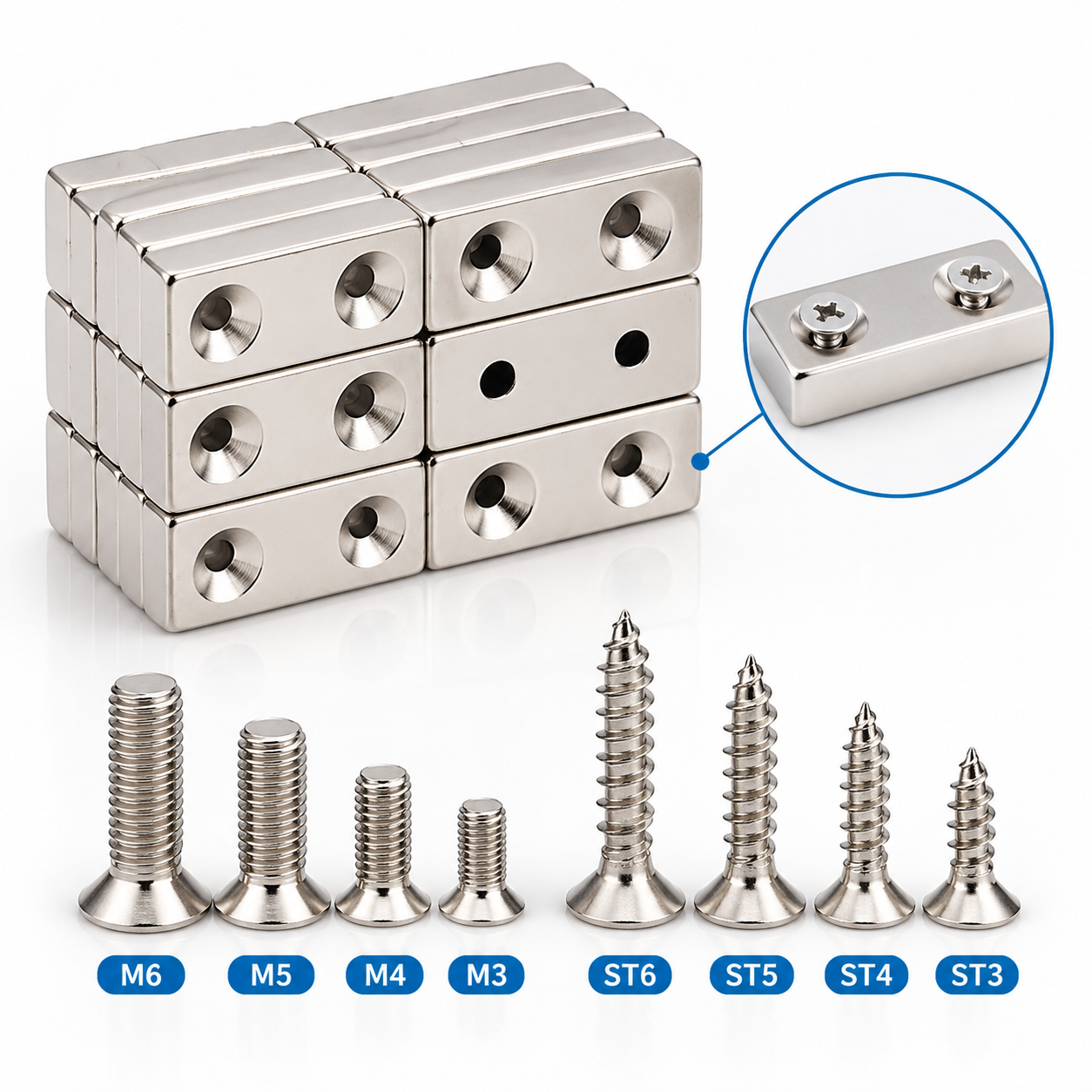
When sourcing square or rectangular countersunk neodymium magnets, unit price and material grade are easy to compare. Assembly conditions are easier to overlook. A sample that holds firmly to a steel plate does not guarantee that thousands of magnets will fit and perform consistently on a production line.
For manufacturers of automation equipment, furniture hardware and industrial components, unexpected costs often come from hole position errors, protruding screw heads, incorrect polarity and inconsistent holding force. These issues should be addressed during quotation and sampling.
Before Comparing Quotations
Send the same drawing revision, screw specification, assembly conditions and acceptance requirements to each supplier.
01. Confirm the Screw and Countersink Before Finalizing Dimensions
“A square magnet with a countersunk hole for an M4 screw” is not a complete manufacturing specification. Screws with the same thread size can have different head diameters, angles and heights. A countersink made to an assumed specification may leave the screw head protruding, create a gap between mating surfaces or cause the hole edge to crack during tightening.
The purchasing drawing should specify magnet length, width and thickness; through-hole diameter; countersink diameter and angle; hole position; and which face is countersunk. For projects with an existing screw, providing its drawing or a physical sample is more reliable than stating the thread size alone.
Sample approval should include assembly with the actual mounting base and screw. Check the installed surface level and inspect the hole edges after tightening.
02. Define Holding Force Under Repeatable Test Conditions
A supplier may test a magnet in direct contact with a thick steel plate, while the customer uses a thin painted panel with a plastic or decorative layer in between. Under different conditions, a magnet that passes the supplier’s test may still provide insufficient holding force in the finished assembly.
The enquiry should therefore identify:
The mating material, its thickness and surface finish.
Any gap between the magnet and the mating component.
Whether the load acts perpendicular to the surface or slides along it.
The required load and expected vibration conditions.
Where holding force is critical, agree on the test fixture, contact conditions, pulling direction and acceptance range. N52 can be specified as a material grade, but it cannot replace testing in the intended assembly.
03. Include Polarity in the Purchase Specification
If the magnet works against another magnet, the polarity of the countersunk face directly affects assembly. One sample pair attracting correctly does not establish that bulk parts can be installed without checking orientation.
Before ordering, confirm the magnetization direction, the polarity of the countersunk face and whether matched pairs are required. Where parts must be distinguished, agree on package labels or separate packing so operators can identify them without checking every piece.
04. Match Coating Acceptance to the Working Environment
An acceptable nickel–copper–nickel finish does not establish suitability for every corrosive environment. If magnets will encounter workshop humidity, condensation or cleaning chemicals, disclose those conditions before selecting the coating and validation requirements.
If salt spray testing is required, specify the test method, duration and acceptance criteria in the order. Inspect countersink walls and edges for incomplete coverage, peeling or exposed base material, as well as the appearance of the flat surfaces.
05. Run a Pilot Assembly Before Releasing the Bulk Order
A pilot run using the actual assembly process provides more useful evidence than repeated confirmation that a part can be manufactured. Check whether magnets are easy to separate and handle, whether the screws fit correctly, whether tightening causes chipping and whether holding force remains consistent after installation.
Once approved, document the drawing revision, approved samples, inspection requirements and packaging instructions. Changes to the screw, coating or hole geometry should trigger a review of the affected requirements.
Bulk Order Approval Checklist
| Item | Confirm Before Production |
|---|---|
| Drawing | Revision, dimensions, hole geometry and tolerances. |
| Assembly | Actual screw, mounting base and tightening method. |
| Performance | Holding-force test conditions and acceptance range. |
| Polarity | Magnetization direction, face polarity and identification. |
| Coating | Finish, inspection criteria and any corrosion test. |
| Delivery | Pilot approval, packaging and batch identification. |
For bulk purchases of countersunk neodymium block magnets, dimensions, grade and price are only part of the specification. Clear assembly and acceptance conditions make quotations comparable and help turn an approved sample into repeatable production deliveries.