
Square vs. Round Magnetic Bars: Which Profile Fits Your Industrial Setup Better?
Square and round magnetic bars are used to capture iron particles from materials or to hold steel parts in purpose-designed assemblies. The main difference is how their shape fits the equipment, the material flow and the cleaning method.
In our equipment projects, we usually start with three questions: Where will the bar be installed? How will material pass it? How will it be cleaned? These questions help narrow down the choice.
Square and Round Magnetic Bars at a Glance
| Comparison | Square Magnetic Bars | Round Magnetic Bars |
|---|---|---|
| Installation | Flat sides fit against flat brackets or matching locating slots. | Fit round openings and saddle supports. |
| Orientation | A matching slot or bracket helps keep the working face pointed in one direction. | Can rotate unless the mounting arrangement holds them in position. |
| Working surface | Flat faces suit sidewall arrangements and planar interfaces. | Curved surfaces suit material passing around the bar. |
| Material flow | Often used along walls or in structured arrays. | Commonly used across falling-material paths and liquid flow channels. |
| Cleaning | Cleaning access depends on face position, spacing and corner geometry. | Commonly paired with round removable sleeves for easier cleaning. |
| Typical uses | Rectangular housings, sidewall arrays and positioning or holding fixtures. | Grate separators, hoppers, liquid-line assemblies and sleeve-cleaning systems. |
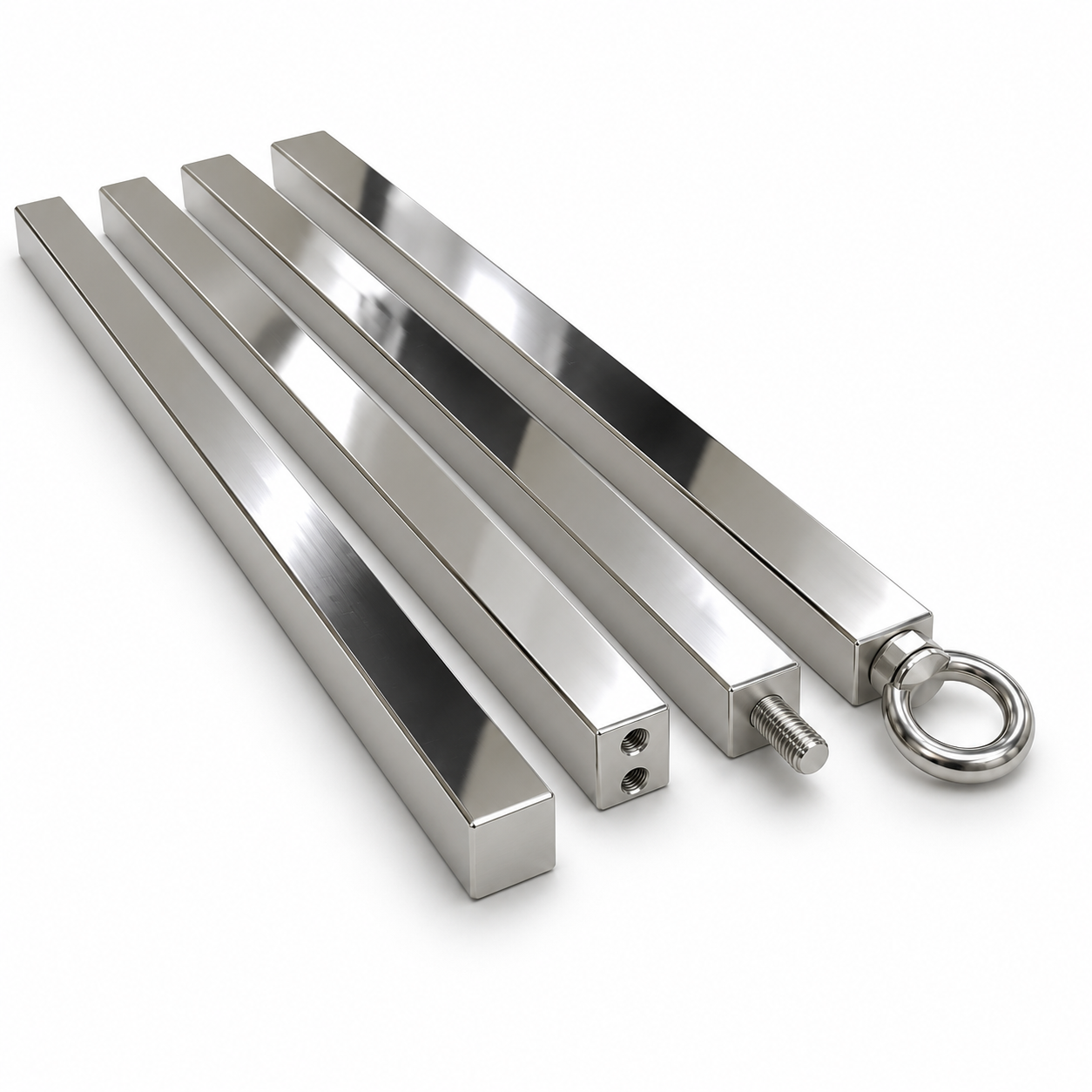
Where Square Magnetic Bars Are Useful
Flat Mounting Surfaces and Fixed Orientation
We use square magnetic bars where a flat side needs to sit against a bracket or inside a matching slot. This gives the assembly a clear locating surface and helps keep its working face in the intended direction.
This arrangement is useful in positioning fixtures and equipment exposed to vibration. Clamps or end fasteners secure the bar, while the matching flat surfaces control its orientation.
Rectangular Housings and Sidewall Arrays
Square bars can fit neatly against the flat walls of a rectangular enclosure. Several bars can be arranged along a sidewall, with their working faces directed toward the material path.
In these layouts, we consider bar spacing and access for cleaning alongside the available installation space.
Flat-Part Holding Applications
Square housings can also form part of magnetic assemblies used beneath conveyors or beside flat steel components.
For these applications, we design the internal magnetic circuit around the required holding position, working gap and release method. A holding assembly has different requirements from a bar used to collect iron particles.
Where Round Magnetic Bars Are Useful
Falling Powders and Granules
We commonly use round magnetic bars in grate arrangements inside hoppers and chutes. Material passes through the spaces between the bars, bringing iron particles close to the magnetic surfaces.
The curved profile allows material to flow around the bars. We set the spacing to balance material passage with access to the magnetic capture zones.
Liquid Flow Channels
Round bars also suit installations where liquid passes around the magnetic surface. Their curved shape generally presents a smoother obstruction than a flat face placed across the same flow path.
The complete arrangement—including bar size, spacing and housing geometry—determines how the liquid moves through the assembly.
Removable-Sleeve Cleaning Systems
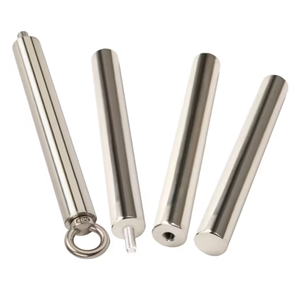
Round magnetic bars are well suited to cylindrical cleaning sleeves. During cleaning, the magnetic core is withdrawn from the sleeve, allowing collected metal to be removed more easily.
We account for the withdrawal space when laying out this type of assembly.
Does a Square Bar Have More Magnetic Strength?
We assess magnetic performance through the internal design and the actual working distance. Shape alone does not establish which bar will provide the stronger useful field.
Magnet grade, pole arrangement, housing thickness and the gap to the target all affect performance. For high gauss magnetic bars, a surface reading describes the field at the measurement point; we also examine the field where the material or component will actually pass.
In a square vs round magnetic rods comparison, we therefore consider both the mechanical fit and the required magnetic working zone.
How to Compare Sizes
We compare each profile within the complete installation space.
A 25 × 25 mm square bar has a diagonal of approximately 35.4 mm. It will need more clearance to pass through a circular opening than a round bar with a 25 mm diameter.
Inside a rectangular housing, the square bar may provide a convenient flat mounting face. We also leave room for brackets, material passage and removal during maintenance.
What We Check During Manufacturing
For square magnetic cores, we use controlled chamfers or rounded edge transitions and assembly fixtures to protect the corners from chipping.
For sealed SUS304 or SUS316L housings, we use continuous laser welding and finished-assembly air-tightness testing under defined conditions.
We check each bar’s magnetic field at specified positions and measurement distances. We also match the magnet grade to the continuous operating and cleaning temperatures, including standard N-series and higher-temperature UH/EH options.
A Simple Way to Choose
We generally favour square magnetic bars when flat mounting, fixed orientation or sidewall installation is the main requirement.
We generally favour round magnetic bars when the equipment uses circular openings, material needs to flow around the bars, or removable cleaning sleeves are part of the design.
The most useful starting point is the equipment layout: installation space, material path and cleaning access usually make the choice clear.