
Magnetization Types
Magnetization Types of Neodymium Magnets
Permanent magnets achieve their magnetic properties through a process called magnetization, where a strong magnetic field aligns the internal magnetic domains of the material.
Different applications require different magnetization directions and magnetic pole configurations.
At Magnet Forever, we provide a wide range of magnetization solutions to meet various industrial and engineering requirements.
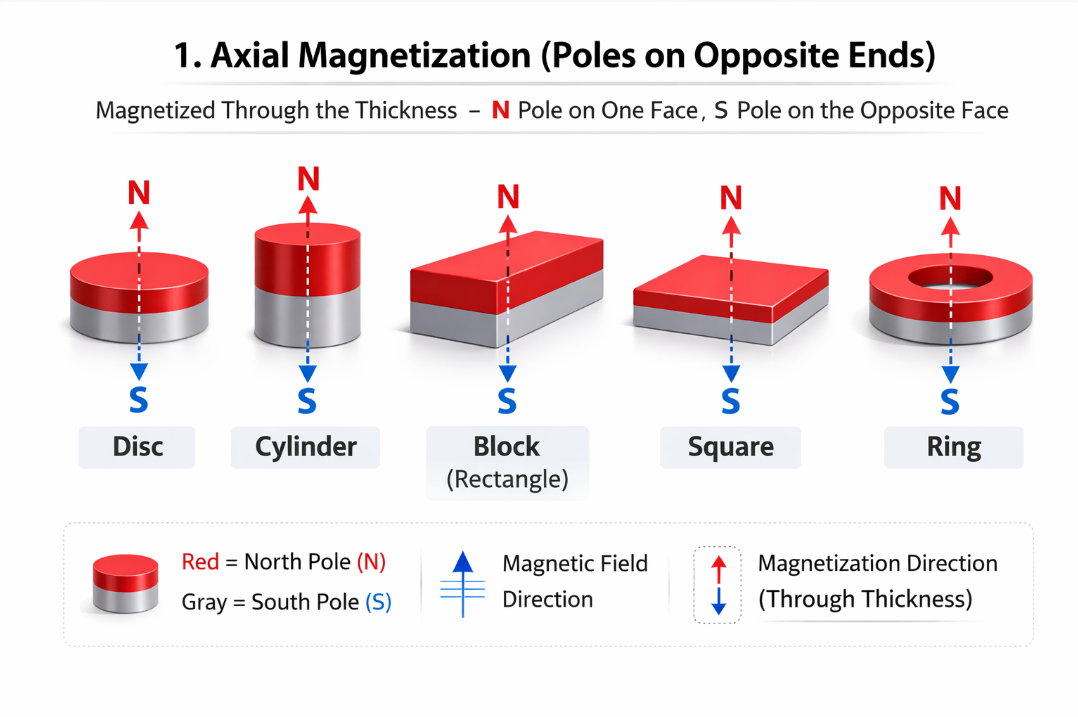
1. Axial Magnetization
Description
Axial magnetization means the magnetic poles are located on the top and bottom surfaces of the magnet.
For example, in a disc magnet:
The north pole (N) is on one flat face
The south pole (S) is on the opposite face
The magnetic field flows through the thickness of the magnet.
Typical Shapes
Disc magnets
Cylinder magnets
Block magnets
Common Applications
Magnetic sensors
Magnetic holders
Magnetic couplings
Small electric motors
Advantages
Simple magnetization process
Stable magnetic field distribution
Suitable for many standard applications
1. Axial Magnetization
Description
Axial magnetization means the magnetic poles are located on the top and bottom surfaces of the magnet.
For example, in a disc magnet:
The north pole (N) is on one flat face
The south pole (S) is on the opposite face
The magnetic field flows through the thickness of the magnet.
Typical Shapes
Disc magnets
Cylinder magnets
Block magnets
Common Applications
Magnetic sensors
Magnetic holders
Magnetic couplings
Small electric motors
Advantages
Simple magnetization process
Stable magnetic field distribution
Suitable for many standard applications
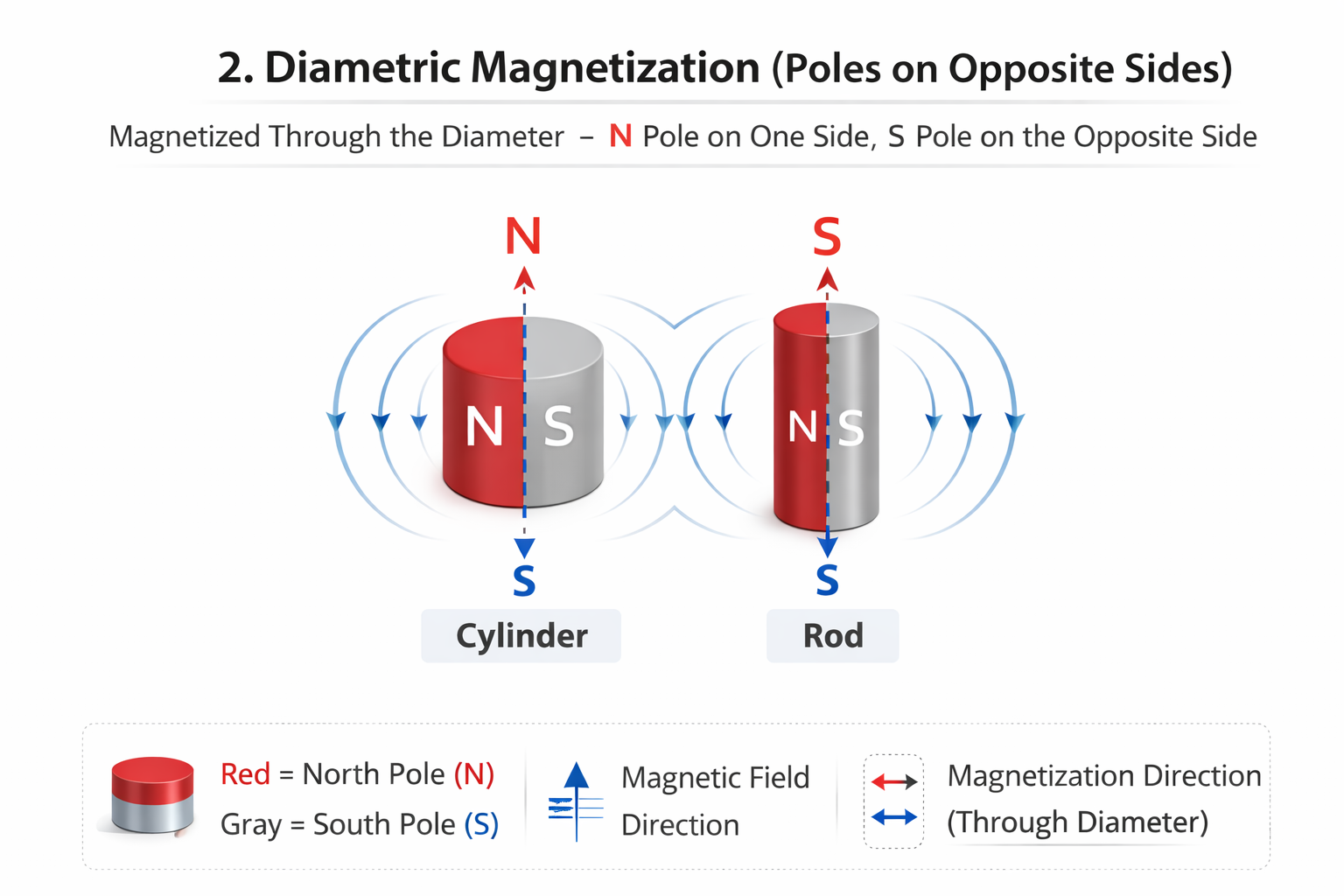
2. Diametric Magnetization
Description
Diametric magnetization means the poles are located on two opposite sides across the diameter of the magnet.
Instead of being magnetized through the thickness, the magnetic field runs across the diameter.
Typical Shapes
Cylindrical magnets
Rod magnets
Common Applications
Rotary sensors
Magnetic encoders
Precision instruments
Advantages
Ideal for rotating magnetic fields
High accuracy in sensor applications
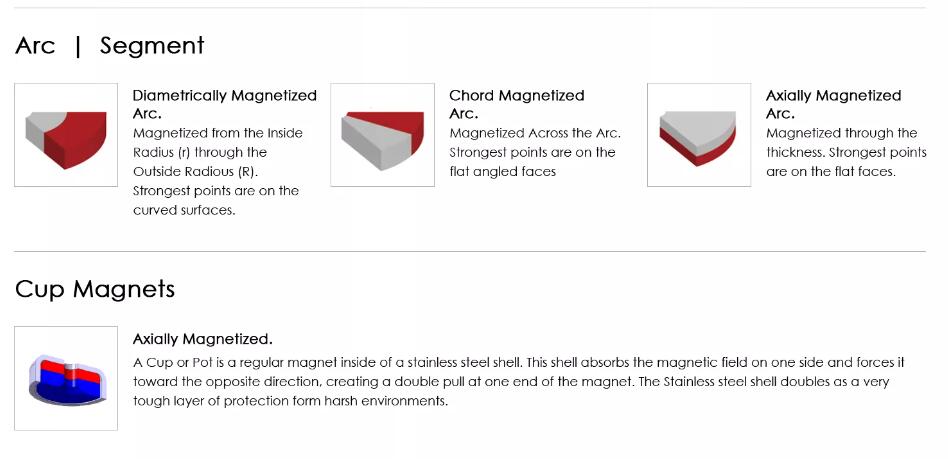
3. Radial Magnetization
Description
Radial magnetization is commonly used for arc or ring-shaped magnets.
The magnetic field radiates from the center outward.
This type of magnetization is widely used in electric motors and generators.
Typical Shapes
Arc magnets
Ring magnets
Common Applications
Brushless motors
Servo motors
Electric vehicle motors
Generators
Advantages
Creates a uniform rotating magnetic field
Improves motor efficiency and torque output
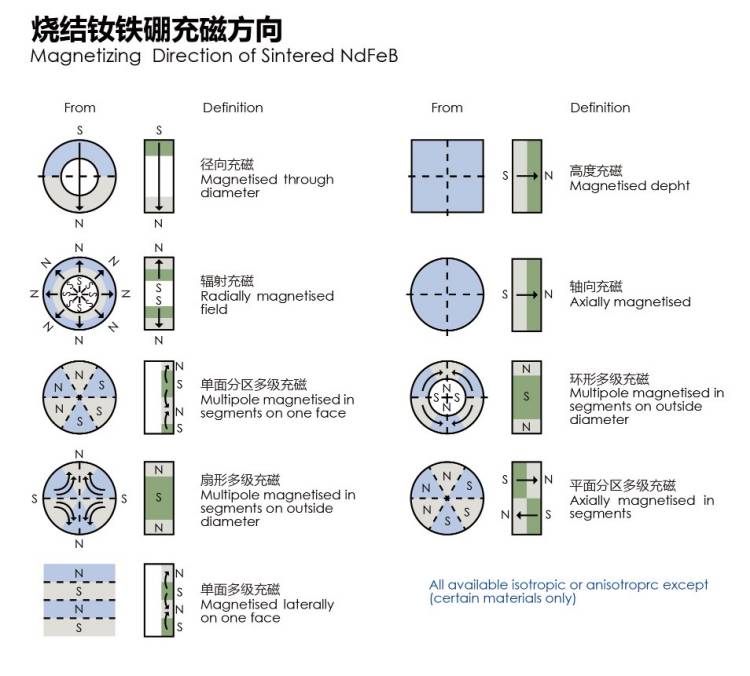
4. Multi-Pole Magnetization
Description
Multi-pole magnetization means the magnet surface contains multiple alternating north and south poles.
Instead of a single N and S pole, the magnet can have:
4 poles
8 poles
12 poles
or more
Common Applications
Magnetic encoders
Magnetic rollers
Stepper motors
Magnetic sensors
Advantages
Precise magnetic field control
Improved rotational detection accuracy
5. Custom Magnetization
Some applications require special magnetic field patterns.
Our engineering team can design custom magnetization solutions based on your application requirements.
Examples include:
asymmetric pole distribution
special encoder magnets
custom multi-pole rings
complex magnetic assemblies
We can assist customers in selecting the optimal magnetization method for their designs.
Magnetization Equipment & Testing
At Magnet Forever, magnets are magnetized using high-power magnetizing equipment capable of generating extremely strong magnetic fields.
Each magnet is tested after magnetization to ensure:
correct magnetic pole orientation
proper magnetic strength
consistent flux distribution
Testing equipment includes:
Gauss meters
Helmholtz coils
Flux measurement systems
How to Choose the Right Magnetization Type
When selecting magnetization type, the following factors should be considered:
magnet shape
application environment
magnetic field direction required
rotation or linear motion requirements
Our technical team can assist customers in choosing the most suitable magnetization method.
Need Help with Magnet Design?
If you are unsure about the best magnetization type for your project, our engineering team can provide professional support.
Contact us to discuss:
magnetization direction
magnetic circuit design
Contact Us
Looking for high-performance magnets for your application?
Contact us today to discuss your project and receive customized magnet solutions.
Request a Quote
Send Your Drawing